"If every time men had sex, they risked death, physical disability, social shunning, a life altering interruption of their
education or career, and the sudden life-long responsibility for another being, i think they'd expect a choice in the
matter."
I don't know who said this originally but whoever it was, thank you for the words I couldn't come up with myself.
And our illustrious UnSupreme Court is getting ready to roll back Environmental laws so we can further damage and hasten the demise of our Earth.
The corruption and illegitimacy of the Supreme Court.
As currently constituted, the Supreme Court is illegitimate and corrupt. It is illegitimate because two justices appointed by Trump resulted from norm-busting “rules” made up by Mitch McConnell on the fly. Gorsuch sits in a seat stolen from an Obama appointee, and Barrett sits in a seat that belonged to the incoming president.
The Court is corrupt because Gorsuch, Kavanaugh, and Barrett lied to the Senate about their pre-determined intent to overrule Roe v. Wade. And it is corrupt because Justice Thomas has refused to recuse himself from cases in which his wife assisted in an attempted coup.
The trust of the American public in the Court has plummeted to an all-time low of 25%. It will decline further if the January 6th Committee proves that Ginny Thomas funneled information about Court deliberations to John Eastman. It will fall further if the Committee demonstrates that Justice Thomas knew of and condoned his wife’s insurrectionist activities.
The hypocrisy and intellectual dishonesty of the court’s right-wing justices lead to the conclusion that they have simply appointed themselves super-legislators free to impose a view of the United States as a White, Christian and male-dominated society despite the values, beliefs and choices of a majority of 330 million modern Americans.
The court’s decision may result in women’s deaths. But it has certainly killed off what is left of the court’s credibility. And for that, there is no solution in sight.
American democracy if it is to endure needs a SCOTUS widely accepted as an impartial referee, but this Court, by how it was constituted & by rulings that appear to be more about policy than law, has for many forfeited its legitimacy. Our democracy is in deeper danger as a result.
" As the Supreme Court stands on the brink of loosening gun restrictions and rolling back decades of abortion protections, tax documents obtained by CREW show that the dark money group that poured millions of dollars into helping former President Trump swing the Court sharply to the right raised a record $48.1 million between July 2020 and June 2021, all from deep-pocketed donors who will remain secret.
Filing as the Concord Fund, but better known by its alias, the Judicial Crisis Network (JCN), the group has deep ties to Federalist Society co-chairman Leonard Leo, who played a key role during the Trump years helping select Trump’s judicial nominees. Throughout that time, JCN acted as the firepower in the effort to reshape the judiciary, spending millions of dollars from anonymous donors on ads to stymie President Obama’s nomination of Merrick Garland and to boost Trump nominees Neil Gorsuch, Brett Kavanaugh and Amy Coney Barrett.
The period covered by the filing includes the confirmation battle over now-Supreme Court Justice Barrett. During that time, JCN spent millions of dollars around the country promoting Trump’s chosen nominee to replace Justice Ruth Bader Ginsburg. As part of the advocacy effort, JCN also set up a website with glowing information about Barrett’s background and record.
Once the confirmation and election passed, the Concord Fund spent another $1 million, under the JCN moniker, on ads sounding alarms about the thus far nonexistent threat of court packing, even using it as an opportunity to attack “left-wing dark money groups,” without apparent irony. Later, under yet another name — Free to Learn Action — the Concord Fund created an ad campaign that targeted the teaching of racial justice topics in school"
"For nearly two decades now, Leonard Leo and the Concord Fund, by any name, have been one of the driving forces behind the push to reshape the court and overturn Roe v. Wade, and a recent leaked draft opinion suggests that this dream is about to be realized. Judicial Crisis Network’s president Carrie Severino has already celebrated the opinion, but their work will not end there. The Concord Fund and the small network of well-funded groups tied to Severino and Leo are already engaged in efforts to restrict voting and fight “left-wing dark money” — all without disclosing any of the donors behind its $48.1 million haul. "
Saturday, June 11, 2022
Friday, June 10, 2022
Wednesday, June 08, 2022
Tuesday, June 07, 2022
Sunday, June 05, 2022
Michael Hiltzik is a brilliant columnist for The Los Angeles Times.This article is the single best analysis of gun control that I have read anywhere. In it, Hiltzik demonstrates the fallacies of those who oppose gun control. The Second Amendment does not give unlimited rights to own guns. Gun control is supported by majorities. Effective gun control saves lives. Why should the right to own a gun be more sacred than the right to life?
Hiltzik writes:
Another massacre, another outpouring of political balderdash, flat-out lies about gun control and cynical offers of “thoughts and prayers” for the victims.
I haven’t commented on the slaughter of 19 children and two adults in Uvalde, Texas, by an assault rifle-wielding 18-year-old before now, hoping that perhaps the passage of time would allow the event to become clarified, even a bit more explicable.
But in the week since the May 24 massacre, none of that has happened. The news has only gotten worse. It’s not merely the emerging timelines that point to the inexcusable cowardice of local law enforcement at the scene, but the ever-growing toll of firearm deaths across the country.
The right secured by the Second Amendment is not unlimited.
— Justice Antonin Scalia, District of Columbia vs Heller
There have been 17 mass shootings nationwide since Uvalde, including 12 on Memorial Day weekend alone. A mass shooting is defined by the Gun Violence Archive as one in which four people or more are killed or wounded, not including the shooter.
What is most dispiriting about this toll is the presumption that campaigning to legislate gun safety is fruitless, because gun control is unconstitutional, politically unpopular, and useless in preventing mass death.
These arguments have turned the American public into cowards about gun control. Voters seem to fear that pressing for tighter gun laws will awaken a ferocious far-right backlash, and who wants that?
Yet not a single one of these assertions is true, and repeating them, as is done after every act of mass bloodshed, doesn’t make them true. The first challenge for those of us concerned about the tide of deaths by firearms in America is to wean the public and public officials from their attitude of resignation.
We’ll skip lightly over a few of the more ludicrously stupid claims made by politicians and gun advocates about Uvalde.
For example, that the disaster could have been averted if the school had only one door, says Sen. Ted Cruz (R-Texas); apparently Cruz is ignorant of the Triangle Shirtwaist Factory disaster, in which 146 garment workers died, many because they could not escape the factory through its locked doors.
But that happened in 1911, and who can expect a Senator to remain that au courant?
Or the assertion by Texas Gov. Greg Abbott and many others that the problem leading to Uvalde isn’t the epidemic of assault weapons, but mental illness. This is nothing but an attempt to distract from the real problem.
“Little population-level evidence supports the notion that individuals diagnosed with mental illness are more likely than anyone else to commit gun crimes,” a team from Vanderbilt University reported in 2015.
Finally, there’s the argument that the aftermath of horrific killings is not the time for “politics.” In fact, it’s exactly the time for politics. Mass death by firearm is the quintessential political issue, and there’s no better time to bring it forward than when the murders of children and other innocents is still fresh in the public mind.
Let’s examine some of the other common canards about gun violence and gun laws, and start thinking about how to move the needle.
The 2nd Amendment
For 217 years after the drafting of the Bill of Rights, which included the 2nd Amendment, courts spent little effort parsing its proscription that “A well regulated militia, being necessary to the security of a free state, the right of the people to keep and bear arms, shall not be infringed.”
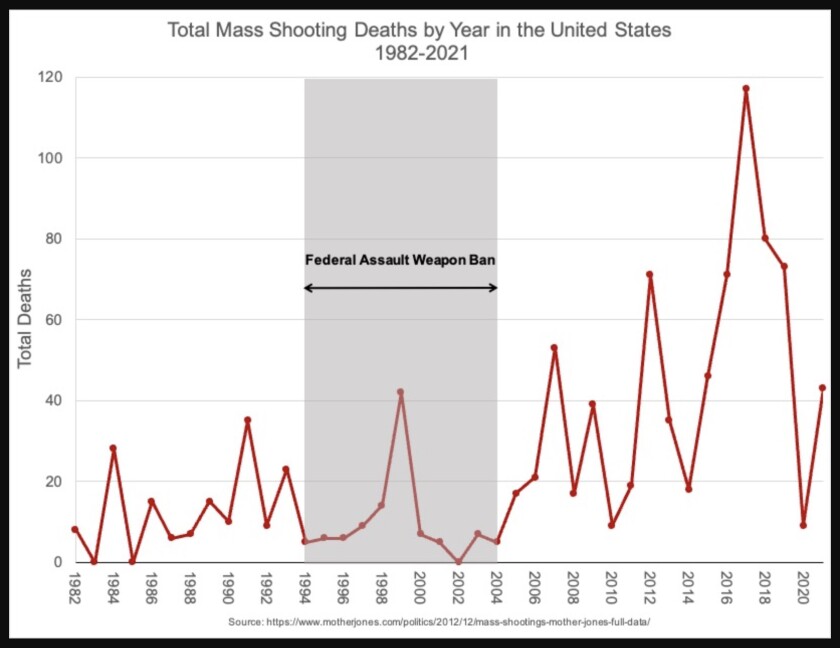
Since the federal ban on assault weapons expired in 2004, mass shootings with those weapons has climbed. An assault weapon was used in the Uvalde massacre of May 24. (Mother Jones)
That changed in 2008, with the Supreme Court’s ruling in the so-called Heller case overturning the District of Columbia’s ban on possession of handguns in the home. Since then, the impression has grown — fostered by the National Rifle Assn. and other elements of the gun lobby — that Heller rendered virtually any gun regulation unconstitutional.
But Justice Antonin Scalia’s 5-4 majority opinion said nothing of the kind. Indeed, Scalia explicitly disavowed such an interpretation. “The right secured by the Second Amendment is not unlimited,” he wrote. The Constitution does not confer “a right to keep and carry any weapon whatsoever in any manner whatsoever and for whatever purpose.”
There was, and is, no constitutional prohibition against laws prohibiting the carrying of concealed weapons, he found. Nothing in his ruling, he wrote, should “cast doubt on longstanding prohibitions on the possession of firearms by felons and the mentally ill, or … the carrying of firearms in sensitive places such as schools and government buildings,” or conditions on gun sales.
The problem with the D.C. law, Scalia wrote, was that it went too far by reaching into the home and covering handguns, which were popular weapons of defense in the home. “The Constitution leaves the District of Columbia a variety of tools” for regulating handguns, as well as other firearms, he wrote.
The federal assault weapons ban, which was enacted in 1994 and expired in 2004, repeatedly came under attack in federal courts, and prevailed in every case. Not a single one of those challenges was based on the 2nd Amendment. Since the expiration of the ban, mass shooting deaths in the United States have climbed steadily.
“Heller has been misused in important policy debates about our nation’s gun laws,” wrote former Supreme Court clerks Kate Shaw and John Bash in a recent op-ed. “Most of the obstacles to gun regulations are political and policy based, not legal.” Shaw and Bash worked on the Heller decision as clerks to Scalia and John Paul Stevens, the author of the leading dissent to the ruling, respectively.
So let’s discard the myth that gun control laws are unconstitutional.
The NRA
By any conventional accounting, the NRA is a shadow of its former self. Its leadership has been racked with internal dissension, its resources have been shrinking and it has faced a serious legal assault by New York state. Attendance at its annual convention last week in Houston drew only a few thousand members, even with former President Trump on hand to speak.
Yet the organization still carries major political weight. To some extent that’s an artifact of its political spending. Even in its straitened circumstances it’s a major political contributor, having handed out more than $29 million in the 2020 election cycle. Some of the politicians taking resolute pro-gun stands are beneficiaries of this largess, mouthing “thoughts and prayers” for the victims of gun massacres while pocketing millions from the NRA.
The NRA also has played a lasting role in blocking funds for research into gun violenceby federal agencies such as the Centers for Disease Control and Prevention, an obstacle that remained in place for some two decades until Congress restored funding in 2019. But the gap in research still hampers gun policymaking. It’s long since time to curb this organization’s blood-soaked influence on our politics.
Debate? What debate?
Part of the knee-jerk news coverage of the aftermath of gun massacres is the notion that the American public is deeply divided over gun regulations. This is a corollary of the traditional claim that American society is “polarized,” which I showed last year to be absolutely false. The truth is that large majorities of Americans favor abortion rights, more COVID-related restrictions and, yes, gun regulations.
More than 80% of Americans favor instituting universal background checks on gun buyers and barring people with mental illness from owning guns, according to a Pew Research Center poll. More than 60% favor banning assault weapons and high-capacity ammo magazines.
The poll was taken last September; it’s a reasonable bet that the majorities would be larger now. To put it another way, the “debate” is over — most Americans want to bring gun sales and ownership under greater control.
Gun regulations work
One claim popular among pro-gun politicians is that gun regulations don’t serve to quell gun violence. (A common version of this trope is that proposed regulations wouldn’t have stopped the latest newsworthy massacre.)
This is a lie, as statistics from the CDC show. States with stricter gun laws have much lower rates of firearm deaths than those with lax laws. The first category includes California (8.4 deaths per 100,000 population) and Massachusetts (3.7). The second group includes Louisiana (26.3) and Texas (14.2, and the highest total gun-related mortality in the country, at 4,164 in 2020).
Texas even loosened its gun regulations just months before the Uvalde massacre. When Missouri repealed its permit regulations for gun ownership in 2007, gun-related homicides jumped by 25% and gun-related suicides by more than 16.1%. When Connecticut enacted a licensing law in 1995, its firearm homicide rate declined by 40% and firearm suicides by 15.4%.
Make them vote
Perhaps the most inexplicable argument justifying congressional inaction over gun laws is that tough laws have no chance of passage, so it’s pointless even to try. Defeatism in the face of urgent need is inexcusable.
The resistance of Republicans to voting for gun laws is precisely the very best reason for bringing those bills to the floor. There’s no reason to give Republican obstructionists a free pass — make them stand up and take a vote.
Make them explain what it is about making Americans safer in schools and workplaces that they find objectionable, and why they think that voting against measures supported by 80% of the public is proper. Bring the fight to them, and show voters the character of the people they’ve placed in high office.
Show the pictures
Americans have become inured to gun violence in part because our culture minimizes its horrors. We’re awash in the most visceral depictions of shootings in movies and television, but at their core those depictions are unthreatening — indeed, in most cases they’re meant for entertainment.
Even our news programs revel in gore — the classic dictum of local news broadcasting has long been “If it bleeds, it leads.”
These conditions have inoculated us against the horror of firearm injuries as they occur in real life — especially those caused by assault weapons such as the AR-15. There’s a big difference between hearing the words “gunshot wound” and learning what actually happens to the organs of victims of AR-15 assaults. They don’t look anything like what we see on TV, and we need to have a true, visceral sense of the difference.
“These weapons are often employed on the battlefield to exact the maximum amount of damage possible with the strike of each bullet,” radiologist Laveil M. Allen wrote last week for the Brookings Institution. “Witnessing their devastating impact on unsuspecting school children, grocery shoppers, and churchgoers is unfathomable. The level of destruction, disfigurement, and disregard for life that a high-powered assault rifle inflicts on the human body cannot be understated. Placed into perspective, many of the tiny Uvalde victims’ bodies were so tattered and dismembered from their ballistic injuries, DNA matching was required for identification because physical/visual identification was not possible.”
You’ll hear the argument that showing photographs of real victims or the scenes of massacres will only be more traumatizing. For some people, including the victims’ families, that may be true. But that only underscores my point — we have not been sufficiently traumatized, and the creation of a truly effective mass movement for gun laws requires that we be traumatized.
Because we experience the horror of gun massacres at a remove, they tend to drift out of public consciousness in a distressingly short time span. Even after the Sandy Hook killings, which took the lives of 20 children ages 6 and 7 less than 10 years ago, there was something distancing about reportage of the event. Photos of some of the murdered children have been made public, but they are photos from life, showing the children smiling at birthday parties or gamboling about the playground.
Let’s face it — few Americans were thinking about the Sandy Hook killings until May 24, when the Uvalde massacre brought them bubbling back to public consciousness. Would our reaction be different had we seen photographs of classrooms slathered in blood, of children’s bodies ripped to pieces by Adam Lanza’s assault rifle?
You bet it would. Those images would not easily be forgotten. Every time a GOP senator or representative stood up to declare that the right to own assault weapons trumped the right of those children to live their lives, someone should have produced one of those photographs and said, “Justify this.”
Our risk is that Uvalde will be just another Sandy Hook. Soon to move off the front burner, or soon buried under the choruses of “We can’t pass this” or “This won’t work” or “This is the path we’ve chosen.” We need to change the terms of discussion, or Uvalde will just be the latest massacre of a long line, not the last massacre of its kind.
Friday, June 03, 2022
1967- The statuesque Jayne Mansfield is killed when her car runs under the rear end of a tractor tailer. Since then, all trailers have a DOT bar at the rear to keep cars from going under them.
1982- Seven people die when Tylenol packaging was tampered with. Since then, it takes a Phd, channel locks, and a sharp object to get into a bottle of pills.
1995- A bombing using a certain kind of fertilizer solution grade ammonium nitrate, killed 168 people, so the government, almost over night imposed severe restrictions on the purchase of the fertilizer.
2001- One person , one, attempts to blow up a plane with a shoe bomb. Since then, all air travelers have to take off their shoes most of the time for scanning before being allowed to board.
Since 1968, 1,516,863 people have died from guns on American soil. Gun violence kills an average of 168 people every two days, and that just went up already since yesterday. Now, the problem apparently can't be solved by politicians. Well, except with condolences, thoughts and prayers.